Many people want a clean yard without mowing, watering, or dealing with mud. Artificial grass seems like the perfect answer. But when people search online, they often find confusing numbers. One website says it costs $5 per square foot. Another says $20. Some give turf prices only. Others show full installation prices. It gets messy fast. So what is the true artificial grass installation cost? And how do you learn to estimate it on your own?
In this guide, I will walk you through everything step-by-step. You will learn what is included in the price, what affects the cost, and how to calculate your own estimate. By the end, you will understand what you should expect to pay and how to avoid paying too much.
1. Why the Artificial Grass Installation Cost Seems Confusing
Most companies advertise low numbers to get your attention. They often show only the turf price, not the labor, tools, base materials, or extras. Many people think they can get a whole yard done for that low number. But the real price becomes much higher once everything is added.
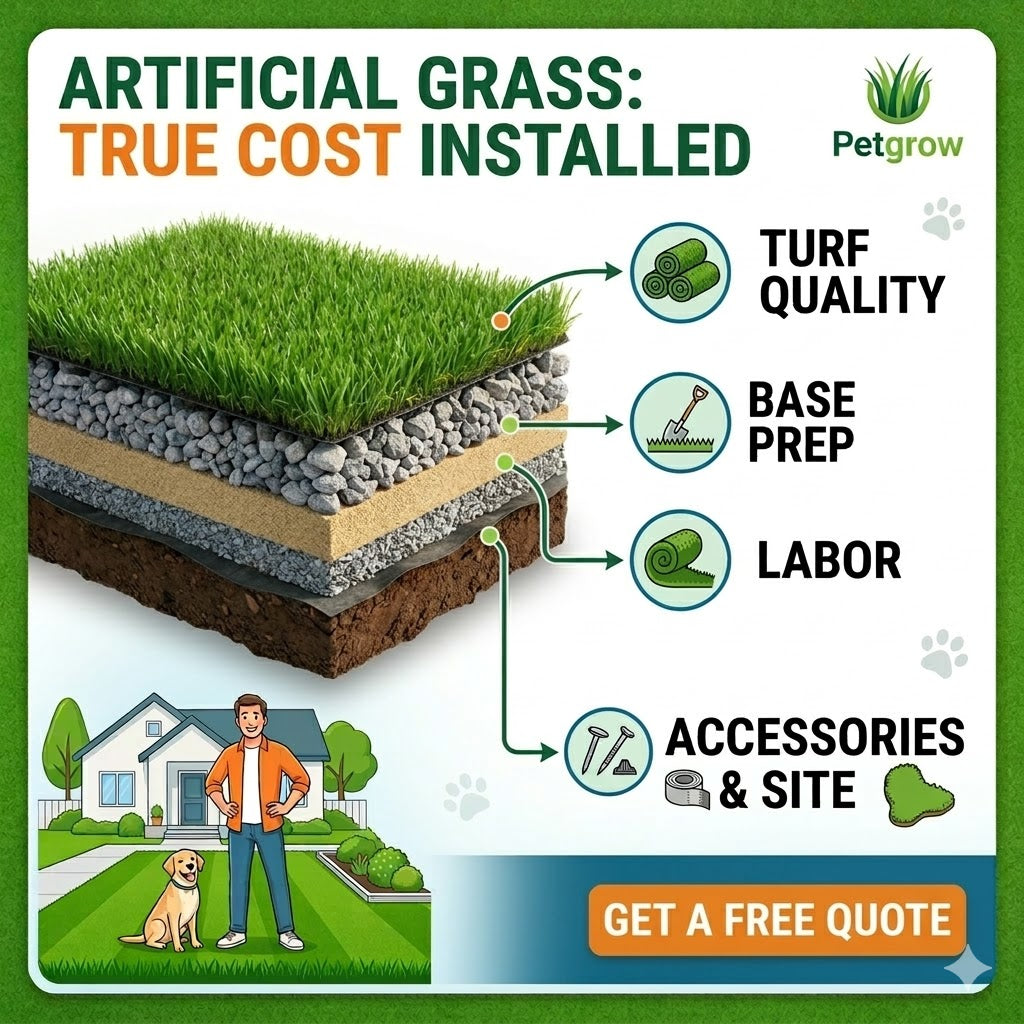
The true artificial grass installation cost includes more than just the grass. It includes the surface under the grass, the prep work, the labor, and the materials that hold everything in place. Once you understand these pieces, the price becomes clearer.

2. What Is Actually Included in the Artificial Grass Installation Cost?
A proper installation has several parts. Each part costs money. Here are the main pieces.
a. Turf material
This is the artificial grass itself. It comes in different qualities. Cheap turf looks flat and shiny. Better turf feels softer and looks real. Turf price depends on height, density, color mix, and fiber type.
b. Base preparation
Installers remove old grass, level the ground, and build a strong base. They add crushed rock, sand, or both. They then compact it to stop future bumps. This step makes the turf last longer.
c. Labor
Workers cut, fit, and attach the turf. They join seams so they look invisible. They secure the edges and clean up the area. Labor is a big part of the cost because it takes skill and time.
d. Infill and accessories
Infill supports the turf blades so they stand up. It also protects the backing. Nail stakes, glue, and edging materials are also needed.
e. Extras
Some yards need more work. You may need draining pipes, weed barriers, or stronger pet systems. Extras can raise the total cost, but they solve real problems.
When you add these parts, the true artificial grass installation cost makes sense. You see why the turf price alone does not tell the full story.
3. What Factors Change the Artificial Grass Installation Cost?
The full price depends on several factors. Understanding these helps you estimate your own cost more accurately.
a. Size and shape
A simple square yard costs less per square foot. A yard with many curves, corners, or odd shapes needs more cutting and waste. More waste means a higher total cost.
b. Turf quality
Better turf costs more, but it lasts longer and looks nicer. Cheap turf wears out faster and may fade sooner. High-traffic homes need stronger turf with higher density.
c. Ground condition
If the yard has rocks, tree roots, old concrete, or many bumps, workers spend more time fixing it. Hard ground may need more base materials. Easy ground means a lower bill.
d. How the yard will be used
A simple decorative area costs less. A yard for kids or sports needs stronger turf and a thicker base. A yard for pets needs special infill and drainage layers.
e. Your location
Labor and service prices vary by city or country. Some areas have high labor costs. Others have cheap labor but expensive materials. Always get local quotes.
These factors help you understand why one home may pay much more or less than another. There is no single price that fits everyone.

4. How to Calculate Your Own Artificial Grass Installation Cost
You can learn to estimate your own cost without guessing. Follow these simple steps.
Step 1: Measure your yard
Sketch your yard on paper. Break it into simple shapes. Measure the length and width of each shape. Multiply to get square footage. Add all areas to get the total.
Step 2: Pick your turf quality
Choose between budget, mid-range, or premium turf. Each level has a price range. Budget turf costs less but may not last as long. Premium turf costs more but looks very real.
Step 3: Estimate base material cost
Most yards need several inches of crushed rock or sand. This base supports the turf and helps water drain. Use the common range for base materials.
Step 4: Estimate labor
Labor depends on area, shape, and difficulty. Larger projects often have better per-square-foot rates. But tricky yards cost more because they take longer to complete.
Step 5: Add extras
Extras include edging, removing old grass, pet upgrades, drainage, weed fabric, or special features. Not every yard needs these.
Example Calculation for 500 Square Feet
Here is a simple example.
-
Turf: $10 per sq ft
-
Base: $4 per sq ft
-
Labor: $6 per sq ft
Total cost per square foot: $20
Total cost for 500 sq ft: $10,000
This is only an example. Your numbers may be higher or lower. But now you know how to calculate the true artificial grass installation cost yourself.
5. Real-World Artificial Grass Installation Cost Examples
Here are three sample projects. These give you a feel for how costs change.
Small Courtyard (150–250 sq ft)
A small space is easy to prepare. Labor is quick. But small jobs may have higher prices per square foot because companies still have travel and setup costs.
-
Budget: $1,200–$2,000
-
Mid-range: $2,000–$3,500
-
Premium: $3,500–$5,000
Average Backyard (400–600 sq ft)
This is a common size for families. Many people choose mid-range turf. Costs vary based on access and base work.
-
Budget: $4,000–$7,500
-
Mid-range: $6,000–$10,000
-
Premium: $10,000–$15,000
Large Yard (800–1,200+ sq ft)
Large yards may cost more overall but less per square foot. Installers save time because big areas allow easier turf placement.
-
Budget: $8,000–$12,000
-
Mid-range: $12,000–$20,000
-
Premium: $20,000–$35,000+
These examples show how size, turf type, and yard shape affect the full artificial grass installation cost.

6. How to Compare Quotes and Avoid Hidden Extra Costs
Comparing quotes helps you avoid paying for things you do not need. But you must know what to look for.
Red flags
Watch out for quotes that:
-
Do not list the turf brand or model
-
Do not mention base depth or materials
-
Do not explain infill type
-
Only show a single lump-sum number
-
Claim very low prices with no details
These often hide weak materials or shallow base work.
Smart questions to ask installers
Ask installers the same questions so you can compare quotes fairly.
-
What turf brand and model do you use?
- What is the turf pile height and density?
- How deep is the base you will install?
- What base materials will you use?
- What type of infill will you add?
- Does the price include removing old grass?
- Does it include edging or borders?
- How long is your installation warranty?
Their answers will show you who is experienced and who is cutting corners.
How to read an itemized quote
A good quote lists turf, base, labor, infill, and extras separately. This helps you see what you are paying for. It also helps you remove things you do not need. Clear quotes also make it easy to compare companies.
Knowing these steps will save you from hidden charges and help you get a fair artificial grass installation cost.
7. DIY vs Professional: Which Cost Makes More Sense?
Installing artificial grass looks simple at first. However, it is more work than many people expect. Here is a simple guide to help you choose.
DIY installation
DIY saves money because you do not pay for labor. But DIY takes time and effort. You must rent a compactor. You must level the base correctly. You must cut and seam the turf without gaps. Mistakes can cause wrinkles, sinking spots, or bad drainage.
DIY works best for:
-
Very small areas
-
Simple shapes
-
Tight budgets
-
People who enjoy hands-on projects
Professional installation
Professionals have the tools and training. They build strong bases and make clean seams. They know how to grade the area so water drains away. Many companies give workmanship warranties.
Hiring pros works best for:
-
Larger yards
-
Yards with pets
-
Sloped or uneven yards
-
Complex shapes or curves
You may pay more at first, but you get a yard that lasts longer and looks better.
8. Is the Artificial Grass Installation Cost Worth It in the Long Run?
Artificial grass costs more upfront than natural grass or sod. However, it can save money over time. You no longer need water, fertilizer, or weekly mowing. You skip lawn tools and repairs. You also save time.
Most people see artificial grass last 12 to 20 years if installed well. Over that time, they save thousands on water and maintenance. Many homeowners feel the investment is worth it because the yard stays green all year and requires less work.
Artificial grass is not best for everyone. If you will move soon, or you live in a very shaded yard where turf may not dry well, natural grass may be better. But for most busy families, the long-term value makes sense.
10. Conclusion: You Can Learn Your True Artificial Grass Installation Cost
Artificial grass offers a clean, low-maintenance yard. But the real price is more than just the turf. It includes base work, labor, infill, and extras. Once you understand these parts, you can estimate your true cost with confidence.
Here’s what to do next:
-
Measure your yard.
- Choose the turf type you want.
- Calculate base, labor, and extra needs.
- Get at least three itemized quotes.
- Compare them using the questions in this guide.
You can now understand and estimate your own artificial grass installation cost. You can also spot bad quotes and choose the right installer. With this knowledge, you are ready to plan your project wisely and avoid surprises.
Share:
The Ultimate Guide to Choosing Artificial Turf Seam Tape for Your PetGrows™ Lawn
Pet Grass for Dogs: How to Choose the Right Surface for Daily Use