
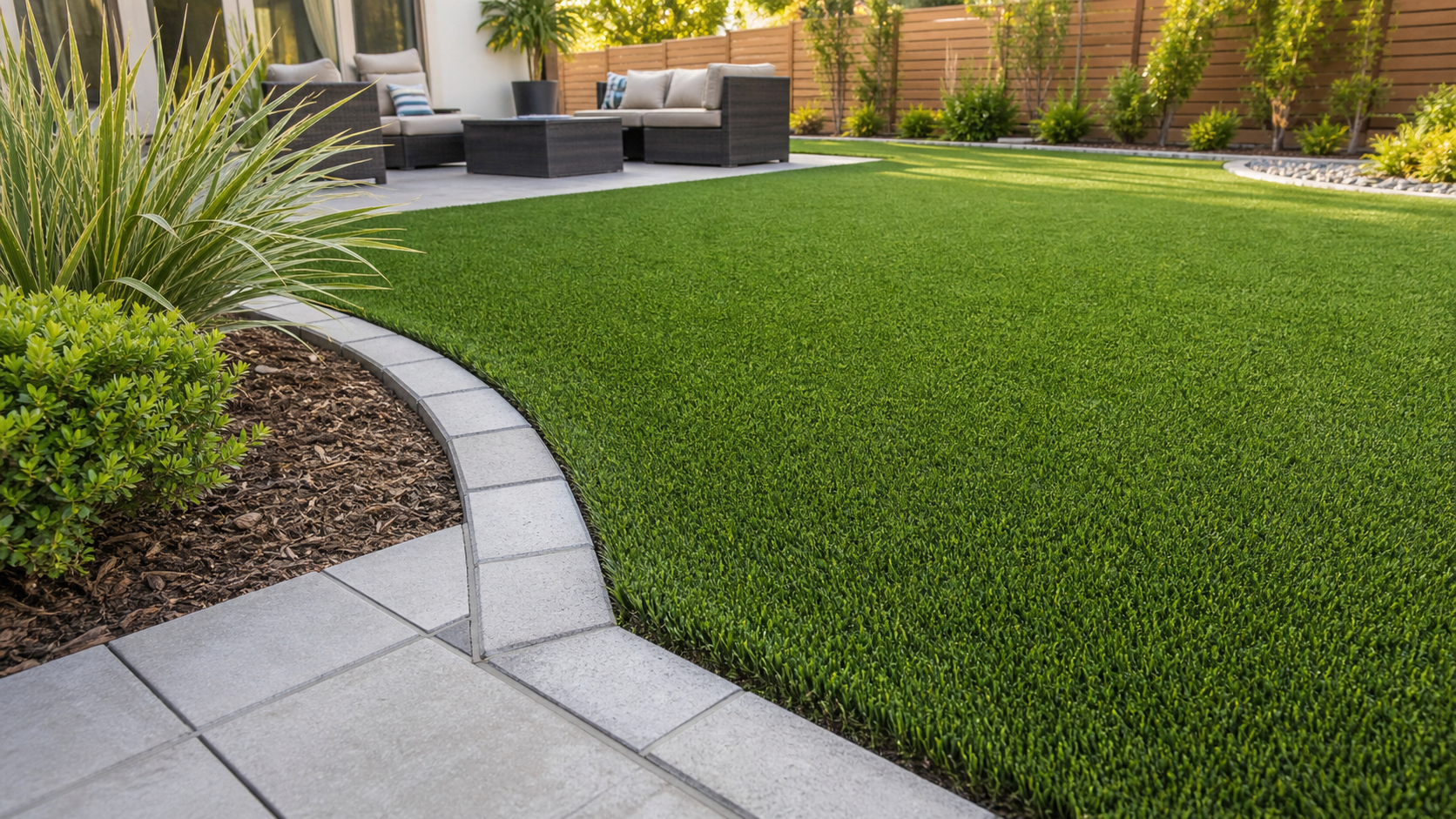
Artificial grass can look great across the middle of a yard and still fail at the edges. That is usually where lifting starts. It is also where base material spreads, infill spills out, weeds sneak through, and a clean install begins to look unfinished.
Good artificial grass edging gives the turf a firm stopping point. It holds the base in place, keeps the perimeter tight, and makes the finished lawn look intentional instead of loose around the sides. This matters even more for dog turf areas, balconies, patios, putting greens, and narrow side yards, where people and pets tend to step on the same edges every day.
This guide focuses only on synthetic turf edging. If you need broader lawn edging ideas for natural grass, brick borders, stone borders, or garden beds, Petgrow already has a separate guide to best turf edging ideas.
Quick answer: what should you use for artificial grass edging?
For most artificial grass projects, the best edging choices are bender board, metal edging, concrete, pavers, or an existing hard surface. The right option depends on the shape of the lawn and how much pressure the edge will take.
| Edging type | Best use | Why it works | Watch out for |
|---|---|---|---|
| Bender board | Curved lawns, dog runs, garden borders | Flexible and easy to stake | Needs enough stakes to prevent waves |
| Steel or aluminum | Modern lawns, straight borders, putting greens | Sharp edge and strong base control | Costs more than plastic |
| Concrete edge | Patios, pool decks, driveways | Solid edge that will not move easily | Harder to change later |
| Paver border | Walkways, patios, turf strips | Clean look and easy mowing edge | Needs a compacted base |
| Existing wall or curb | Balconies, side yards, small pet areas | Already fixed in place | Drainage still needs a path out |
| Timber | Raised areas and rustic yards | Easy to source and simple to cut | Can rot when soil stays wet |
The short version: use a flexible edge for curves, a rigid edge for straight lines, and a hard edge for high traffic areas.
Why artificial grass needs a stronger edge than natural lawn
Natural grass roots into soil. Artificial grass does not. Once synthetic turf is rolled out, trimmed, and secured, the edge has to do much of the holding work.
The edge has several jobs:
- It keeps the compacted base from spreading.
- It gives the turf a clean line to meet.
- It helps stop corners and seams from lifting.
- It keeps infill inside the turf area.
- It creates a visual finish where turf meets mulch, gravel, concrete, or a wall.
If the edge is weak, the rest of the install has to work harder. You may see ripples near the perimeter, soft spots where the base has moved, or a turf edge that curls when someone drags a foot across it.
For pet areas, weak edging creates another problem. Urine and rinse water need to drain through the turf and base. If the border traps water, odor can build up faster. Before installing a small dog potty area, read Petgrow's guide on what to put under artificial grass for drainage.
Bender board for curved artificial grass edges
Bender board is one of the most practical options for artificial grass edging. It is a flexible strip, usually made from recycled plastic or composite material, and it works well when the lawn has curves.

Use it around:
- Curved backyard turf areas
- Dog runs and pet potty zones
- Turf beside planting beds
- Trees or rounded patios
- Small residential lawns with soft shapes
The trick is staking. If you use too few stakes, the board can bow between them. That creates a wavy turf line, which is hard to hide after the turf is cut. Set the curve first, step back, look at it from a few angles, then stake it firmly.
For artificial grass, the base should come right up to the bender board. Compact the base against the edge before laying the turf. After trimming, fasten the turf edge so it sits tight against the board instead of floating above it.
Metal edging for clean synthetic turf borders
Steel and aluminum edging are better when the design is straight, modern, or geometric. Metal gives a thin, crisp line between artificial grass and gravel, mulch, concrete, or planting beds.
Metal edging works especially well for:
- Putting green borders
- Turf strips between pavers
- Modern patios
- Narrow side yards
- Straight backyard lawn edges
- Turf and gravel layouts
If you are building a home putting area, pair metal edging with turf made for golf use, such as Petgrow's golf putting turf. A putting green edge needs to stay smooth because small bumps can affect how the surface plays and looks.
Metal edging usually costs more than basic plastic, but it holds its shape better. Keep the top close to grade. The edge should define the turf line without becoming a raised trip point.
Concrete and paver borders
Concrete and pavers are often the cleanest edge for synthetic turf because they do not move much once installed properly. The turf can be trimmed to meet the hard surface, which makes the grass look built into the space.
This is a good choice beside:
- Patios
- Pool decks
- Driveways
- Walkways
- Outdoor kitchens
- Balcony perimeters
- Dog runs with a hard border
Pavers can also work as a mowing strip when artificial grass meets natural lawn or planting areas. The base matters, though. Pavers set directly on loose soil can sink or tilt. Use compacted gravel and sand so the edge stays even.
For artificial turf installed over or beside hard surfaces, Lowe's artificial grass installation guide recommends preparing the subbase, securing seams and edges, and brushing infill into the fibers.
External reference: Lowe's artificial grass installation guide
Edging around dog turf and pet potty areas
Pet turf edges take more abuse than decorative lawn edges. Dogs turn, scratch, run, and step on the same corners. If the turf is used as a potty area, you also need to think about water flow.

For a small dog potty area, the edge should do three things:
- Hold the turf flat.
- Keep the base from washing out during rinsing.
- Let water drain away instead of trapping it.
Concrete, pavers, and bender board usually work well here. On balconies or patios, the existing wall or curb may form part of the edge, but drainage still matters. Do not seal the turf in so tightly that rinse water has nowhere to go.
For supplies, Petgrow's Grass Accessories collection includes turf staples, artificial lawn tape, weed barrier fabric, and silica sand infill. The right mix depends on whether your turf sits on soil, compacted base, concrete, or a removable pet potty tray.
If odor is the main concern, edging alone will not solve it. Drainage and infill matter more. Petgrow has a separate guide on how to stop dog pee odor in artificial grass.

How to edge artificial grass step by step
This is a simple overview, not a replacement for a full installation plan. Still, most clean synthetic turf edges follow the same order.
1. Mark the finished edge
Use string for straight edges and a garden hose for curves. Do this before digging or cutting anything. A small adjustment at this stage is easy. A small adjustment after the turf is trimmed is not.
Look at the line from the house, the street, and the main seating area. The edge should look smooth from where people will actually see it.
2. Install the edging before the turf
For most projects, install the edging before rolling out the artificial grass. That gives you a fixed shape to build against.
Set bender board, metal edging, pavers, or concrete at a consistent height. If the edge rises and dips, the turf line will look uneven even if the grass itself is good.
3. Build the base to the edge
Bring the base material all the way to the edging. Do not leave a soft gap at the perimeter. Compact the base carefully near the border, because this is where foot traffic often presses down.
If you are installing turf in a pet area, make sure the base supports drainage. For more detail, see Petgrow's guide to artificial turf infill and the comparison of turf sand, zeolite, and silica sand.
4. Roll, relax, and trim the turf
Roll out the turf and let it relax before final trimming. Warm weather helps the backing settle flatter. Use a sharp blade and cut from the back when possible.
Trim slowly along the edge. It is better to take off a little at a time than to cut too much and leave a visible gap.
5. Secure the perimeter
Secure the turf edge with the method that fits the surface. On compacted base, turf nails or staples are common. On hard surfaces, adhesive or seam tape may be used. Follow the product instructions and avoid fastening in a way that blocks drainage.
Petgrow's artificial lawn tape is useful when you need to join pieces or manage seams near the edge. For soil and base installs, U-type turf staples can help keep the perimeter from shifting.
6. Add infill and brush the edge
After fastening, add infill if your turf system calls for it. Brush the fibers upright, especially along the edge where they may flatten during trimming.
Do not dump too much infill against the border. A heavy ridge at the edge can look lumpy and may spill into beds or onto patios.
Common artificial grass edging mistakes
The most common mistake is cutting the turf before the edge is fully set. Once the edge moves, the turf cut no longer matches it.
Another problem is a soft perimeter. If the base is firm in the middle but loose along the sides, the edge can sink or pull away. Compact the base right up to the border.
Wavy bender board is also easy to spot. Use enough stakes and avoid forcing tight curves that the material does not want to hold.
Raised edging can create a trip point. This is especially important beside patios, play areas, and dog runs. Keep the edge neat, but do not make it awkward to walk over.
Finally, do not trap water. Better Homes & Gardens notes that edging helps separate lawns, beds, paths, and patios, but the material has to suit the way the area is used and maintained. For synthetic turf, that includes drainage.
External reference: Better Homes & Gardens landscape edging guide
Which Petgrow turf works best with edged areas?
If the project is a backyard or patio, start with Petgrow's backyard and patio turf. For pet spaces, start with dog pet turf. For golf projects, use golf putting turf.
The edging choice should match the turf use. A decorative strip on a balcony may only need a clean hard border. A dog run needs stronger fastening and better drainage. A putting green needs a smooth perimeter and a very consistent surface.
If you are still comparing turf types, browse the full artificial grass collection before choosing the edge material. The turf pile height, backing, drainage, and use case all affect how the perimeter should be finished.
Artificial grass edging FAQ
Do you need edging for artificial grass?
Most artificial grass installs need some type of edge. The edge keeps the base in place, gives the turf a clean cut line, and helps prevent lifting around the perimeter.
Can you install artificial grass without bender board?
Yes. Bender board is useful for curves, but it is not the only option. Concrete, pavers, metal edging, timber, walls, and existing curbs can also work.
How do you stop artificial grass edges from lifting?
Start with a compacted base that reaches the edge. Trim the turf cleanly, then secure the perimeter with staples, nails, adhesive, or tape depending on the surface. Lifting often happens when the edge is cut well but not fastened well.
Should artificial grass edging be visible?
It depends on the design. Hidden edging works when you want the turf line to look simple. Visible edging, such as pavers or concrete, works when the border is part of the layout.
What is the best edging for dog turf?
Concrete, pavers, and bender board are common choices for dog turf. The best option depends on the size of the area and how water drains. For dog potty areas, drainage and odor control are just as important as the edge material.
Final thoughts
Artificial grass edging is not the flashiest part of a turf project, but it is one of the details people notice when it goes wrong. A loose corner, a wavy border, or a gap beside the patio can make new turf look unfinished fast.
Set the edge first. Build the base all the way to it. Trim slowly. Fasten the perimeter. Then brush the fibers so the edge looks like part of the lawn, not an afterthought.
Share:
Best turf edging ideas for a clean, finished lawn
What Is Turf Cooling Infill and Why Your Lawn Needs It